Wildlife Removal in Medina, OH
Medina holds two kinds of houses side by side: carefully kept older homes around the historic square, with deep eaves and old chimneys, and newer streets at the edge of town where subdivisions meet woods and open fields. Animals work both kinds, just in different places. Call us and tell us about the job — we will confirm the local crew for your county before any work starts.
Why Medina homes see the wildlife they do
Walk a few blocks from the square and the housing tells the story. There are preserved older homes with wraparound porches, carriage-house garages and attic space that runs the full length of the house, and there are in-town streets of smaller mid-century houses whose crawlspaces and additions have settled over decades. Both offer wildlife quiet, dry shelter close to mature trees — and both reward an inspection that looks at the porch, the chimney and the foundation, not just the roof.
Drive outward and the pattern flips. Newer subdivisions were carved from fields and woodlots, so back fences often face the habitat animals were already using. Groundhogs dig along retaining walls and under patio slabs, skunks patrol the edges at dusk, and squirrels move from the remaining tree lines straight onto new roofs. A house can be only a few years old and still sit on a very old animal route.
Our crew treats those as two different jobs sharing one standard: find the actual entry, remove the animal in the way Ohio law allows, close the opening in metal or masonry-grade material that survives freeze and thaw, and clean the space the animal used. Patching the visible hole while leaving the porch void or the second roofline gap open is how the same call comes back next season.
Around the square: older homes, tall attics and old chimneys
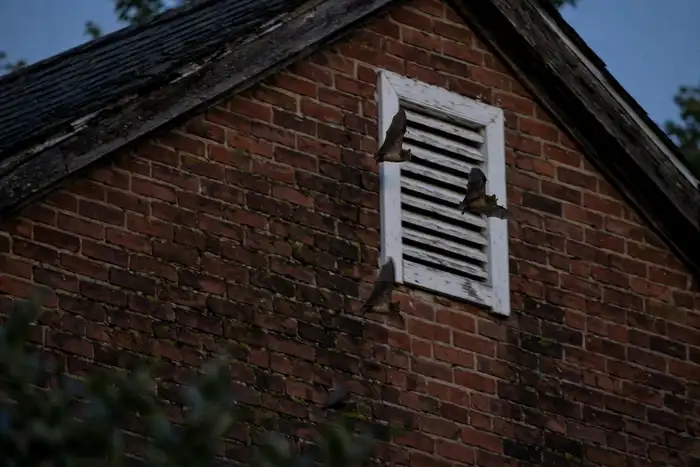
The homes closest to Medina's historic core were built with features wildlife still exploits. Tall attics collect summer heat that draws big brown bats. Masonry chimneys, some serving fireplaces that are seldom lit, make sheltered dens for raccoons in spring. Porches create a dry void underneath that skunks and opossums find in a single night, and older foundations have had a century to open small gaps around pipes, wires and basement windows.
Preservation adds a practical wrinkle: owners understandably want repairs that respect the look of the house. Exclusion can do that. Screening can be set back from a porch face, a chimney cap can be chosen to sit cleanly on an old flue, and roofline metal can be fitted and painted to blend — as long as the material itself is strong enough that a raccoon or squirrel cannot undo it. What does not work on a historic home is soft filler; animals chew through it and the opening returns, usually larger.
If noises are overhead in an older Medina house, the crew checks the chimney and attic together, then works down through the porch and foundation. In this housing stock those spaces are connected more often than owners expect.
At the edges: new subdivisions against woods and fields
Growth at Medina's edges put family neighborhoods right against groundhog burrows, skunk routes and squirrel habitat that predated the streets. Cleared lots leave sunny, soft soil that groundhogs prefer for digging, especially beside sheds, play sets, retaining walls and the slopes around drainage areas. Fences mark a property line for people; for animals they are just something to climb, slip under or dig beside.
Newer construction has different weak points than the in-town stock. Vinyl and composite trim can flex at corners, bathroom and kitchen vents exit through walls and roofs with light covers, and attached garages share an attic or wall void with the house. A squirrel that starts in a garage soffit may be heard later above a bedroom, and a mouse that enters at a utility penetration can travel a whole wall run.
The edge-of-town job therefore starts outdoors: walk the fence line, the shed and the drainage slope, note fresh digging and trails, then inspect the house envelope. Sealing the roof while ignoring a burrow system pushing toward the foundation leaves half the pressure in place.
Wooded lots, mature trees and the fall push indoors
Medina's shade is part of its appeal, and it is also a bridge to the roof. Mature oaks and maples overhang older streets and many newer lots kept their trees, so squirrels can travel canopy to roof without touching the ground. Acorns and other mast draw them close through autumn, which is exactly when cooling nights push squirrels, raccoons and house mice to look for winter shelter inside.
Freeze and thaw do the quiet preparation. Water works into a soffit joint or chimney flashing, freezes, and widens it a fraction; a few winters later the gap fits an animal. Fall is the peak attic-entry season across Medina County for that reason, and a roofline check before the first hard cold is worth more than the same work after an animal has settled, raised the stakes with a litter, and chewed wiring.
Trimming limbs back from the roof helps and our crew will say where it matters, but a squirrel can climb siding, brick and a downspout. Trimming lowers pressure; metal sealing at the entries is what closes the house.
Ohio rules that shape the work: licensing, bats and rabies
Wildlife removal for hire in Ohio requires an ODNR Commercial Nuisance Wild Animal Control Operator license under Ohio Revised Code section 1531.40 — ask us about licensing and insurance when you call. Bats follow a strict calendar under Ohio rules: exclusion is not allowed from May 16 through July 31 when five or more bats are present, because pups cannot fly, or from October 15 through March 31, when big brown bats may be hibernating in the attic, without prior written ODNR permission. The open windows are April 1 to May 15 and August 1 to October 15.
Raccoons, skunks, foxes and bats are Ohio's main rabies vectors, so distance matters when an animal behaves oddly or a bat is found in a sleeping room. Under Ohio Administrative Code 1501:31-15-03(E)(3), a captured raccoon, skunk or opossum cannot be taken away and released elsewhere: the lawful outcomes are release on the same property or humane euthanasia. Our crew leads with exclusion — one-way doors that let an animal leave a structure on its own where that can work — and handles any captured animal exactly as Ohio rules require.
Wildlife we remove in Medina
From bats in a tall attic near the square to groundhogs digging at a subdivision edge, these are the calls Medina homeowners make most.
🐿️ Squirrels
Mature trees overhanging older Medina roofs make fall the big squirrel season, as gray squirrels test soffits and vents pried open by winters of freezing and thawing. Newer homes near woodlots get the same pressure from the tree line behind the fence. See our full Medina squirrel removal guide →
🦝 Raccoons
Unused masonry chimneys on older houses near the square are favorite spring nurseries, and Ohio law does not allow a captured raccoon to be moved and released elsewhere. The work is exclusion first, every kit accounted for, and the den cleaned afterward. See our full Medina raccoon removal guide →
🦇 Bats
Big brown bats use the warm, tall attics of Medina's older homes in summer and hibernate inside some Ohio attics through winter. Exclusion is lawful only April 1–May 15 and August 1–October 15 without written ODNR permission, so an early call protects the timing. See our full Medina bat removal guide →
🦨 Skunks
A skunk under a porch on an in-town street or under a shed at a subdivision edge brings the smell indoors fast. Skunks are a rabies vector and Ohio rules bar moving a captured skunk off the property, so careful exclusion and buried screening do the lasting work. See our full Medina skunk removal guide →
🦫 Groundhogs
Sunny soil at the edges of newer Medina subdivisions is prime groundhog ground, and burrows run under sheds, patio slabs and retaining walls. They sleep through winter, then emerge in late winter and dig hard through spring. See our full Medina groundhog removal guide →
🐾 Opossums
Opossums wander Medina yards at night and bed down in open garages, under decks and beneath porches. Ohio law does not permit taking a captured opossum away for release, so removal is paired with closing the shelter it chose. See our full Medina opossum removal guide →
🐿️ Chipmunks
Chipmunks tunnel tight against foundations, front stoops and porch steps on wooded Medina lots, carrying the soil away so neatly that the damage is easy to underestimate. A busy system can undermine a stoop edge over a few seasons. See our full Medina chipmunk removal guide →
🐀 Rats, mice & voles
House mice pour into Medina basements at first frost, Norway rats turn up in older in-town housing and around outbuildings, and voles leave winding trails under snow that appear at melt. Each one points to a different entry and a different fix. See our full Medina rodent removal guide →
🐍 Snakes
The snakes found in Medina basements and garages are almost always harmless hunters — rat snakes and garter snakes following mice. The useful call is a calm identification and removal, plus a look at the gap and the rodents that drew the snake in. See our full Medina snake removal guide →
🪰 Dead animals
A smell that grows in one room, often as winter turns to spring, usually means an animal died in a wall, an attic or under a porch. Our crew finds it, removes it and cleans the area, then closes the opening the animal used while it was alive. See our full Medina dead animal removal guide →
Animal-specific help in Medina
Deep, local guides for the problems we get called about most — with our wildlife crew behind every one.
How to get help in Medina
Tell us what you're hearing
Scratching in the attic, a snake by the porch, holes in the yard — call with your problem and your Medina address.
We connect you locally
Call us and tell us about the job — we will confirm the local crew for your county before any work starts.
They solve it — for good
Inspection, humane removal, full exclusion and cleanup — handled by our wildlife crew, following Ohio rules.
Common wildlife removal questions in Medina
Who do I call for wildlife removal in Medina?+
Do older homes near the square have different wildlife problems than newer subdivisions?+
What is the busiest season for animals getting into a Medina house?+
Can bats be taken out of my Medina attic in July or in midwinter?+
Will you take a raccoon or skunk from my yard and release it in the countryside?+
How much does wildlife removal cost in Medina?+
Serving all of Medina County
Medina is one part of Medina County. See wildlife removal in Medina County, OH for the county-wide picture — the animals we get called about most, and the other towns we cover.
One call to your Medina wildlife crew
Whether it's squirrels in an older in-town attic or a raccoon in a new subdivision crawlspace, the fastest fix is our wildlife crew, who knows Medina County wildlife. Call us and tell us about the job — we will confirm the local crew for your county before any work starts.
- Local to Medina County. ODNR-compliant handling — call to ask about licensing and insurance.
- One company, one call. Call us and tell us about the job.
- Done right. Removal, exclusion and cleanup.