Armadillo Removal in Zebulon, GA
Armadillos treat a Zebulon lawn the way they treated it when it was pasture: soft soil full of grubs, best dug after rain. Whether your grass borders a hay field or was sodded last spring over one, we work the digging at its source.
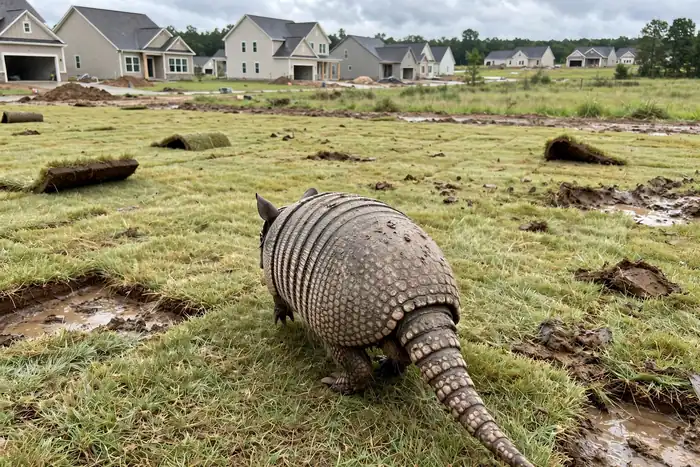
Armadillo Digging Across Zebulon Lawns That Were Recently Field
Few Zebulon lawns announce their history like one being dug by an armadillo. The grass may be new — a subdivision yard sodded over graded pasture, still rooting shallow — but the soil underneath remembers being a field, and it holds the grubs and earthworms armadillos hunt by smell. After a wet night the yard can look ploughed in patches: shallow, cone-shaped holes in clusters, sod flaps lifted and left, a trail of probing that drifts steadily from the pasture side of the lot.
Established country lawns get the same treatment at their edges. Where a farmhouse yard gives up and the pasture begins, armadillos commute out of burrows in the rough ground and feed inward as far as the good soil lasts. The digging is rarely random, and reading its direction — from burrow to lawn, along a fence, around a flower bed — is what turns trapping from guesswork into a short job.
New Subdivision Turf Laid Over Old Pike County Field Soil
Fresh sod is the easiest digging in Zebulon: roots inches deep, soil kept damp by irrigation, grubs thriving in the rich layer beneath. An armadillo can lift and flip new turf in sections rather than digging neat holes, and a yard can go from perfect to patched in one weekend. We pay attention to which yards on a street are hit — usually those backing onto undeveloped field — because the animal is commuting from cover that has not been built on yet.
Pasture-Edge Lawns and the Farmhouse Yard Boundary
On farm properties the pattern starts at the boundary. Burrows open in the rough pasture edge, under fence lines or beneath a fallen tree, and feeding damage fans into the mown yard from there. We walk that boundary first. Finding the home burrow changes the whole job: trapping set between burrow and lawn intercepts the animal on a route it uses nightly, instead of chasing damage that moves every night.
Burrows Under Zebulon Decks, Porches and Outbuildings
Feeding holes are a nuisance; burrows against structures are a problem. Armadillos dig sleeping burrows under low decks, porch slabs, sheds and occasionally at a foundation, loosening soil that should stay put. Any Zebulon call includes a check of those edges: a burrow mouth with fresh spoil under a deck gets addressed in the same plan, and we advise on backfilling and screening once the animal is gone so the next one does not inherit a ready-made den.
Reading Armadillo Sign in a Pike County Yard
The sign is distinctive once you know it: shallow holes a few inches deep with soil nosed aside, tracks with clear claw marks in soft ground, and damage that appears overnight and clusters where the soil is richest. It differs from raccoon sod-rolling and from a dog’s digging, and confusing them wastes effort — a trap set for the wrong animal on the wrong route catches nothing. Our first visit confirms the author before any equipment goes down.
Trapping Along the Route Between Burrow and Feeding Ground
Armadillos navigate by smell and habit more than sight, following the same edges — fence lines, the side of a house, a drainage swale — night after night. Trapping placed on those travel lines, guided by the layout of your lot, outperforms traps scattered across the damaged lawn. Rural Pike County lots give us room to work that pattern properly, and we check sets diligently until the digging stops and stays stopped.
Common armadillo questions in Zebulon
Our new Zebulon subdivision lawn is being torn up — why ours?+
The digging in our yard always starts at the pasture edge — what does that tell you?+
An armadillo has dug under our deck — is that more serious?+
Will treating the lawn for grubs get rid of the armadillo?+
How do you know it is an armadillo and not a raccoon digging?+
We live on a big country lot — do you need to trap the whole property?+
Other Zebulon problems that come with armadillos
Our wildlife crew handles these closely related problems — the ones that most often turn up with a armadillo issue.
Got more than armadillos in Zebulon?
Torn-up turf sometimes has a second author. If the digging pattern shows raccoons rolling sod or rodents working the same soft ground, we will tell you what we are seeing and can fold that removal into the same plan. See everything we handle locally on the Zebulon wildlife removal hub, or jump to Georgia wildlife removal.
Want the background before you call? Read our statewide guide: Armadillos tearing up your Georgia lawn.
Serving all of Pike County
Zebulon is one part of Pike County. See wildlife removal in Pike County, GA for the county-wide picture — the animals we get called about most, and the other towns we cover.
One call to your Zebulon armadillo crew
Call us and describe the digging pattern — where it starts, which way it spreads — and we will set the visit around the animal’s actual route.
- Local to Pike County. Georgia DNR-compliant handling — call to ask about licensing and insurance.
- We trap on the travel line, not in the middle of the damage. Our crew finds the burrow and the paths between burrow, feeding lawn and field cover, places trapping along those lines, and checks any burrow dug against a foundation, porch or outbuilding while we work your Pike County property.
- Done right. Removal, exclusion and cleanup.