Armadillo Removal in Locust Grove, GA
You go out in the morning and the lawn looks like hogs got into it — small cone-shaped holes, mulch thrown out of the beds, maybe a burrow under the deck. That's an armadillo that came in off the field next door. Call us and tell us about the job — we will confirm the local crew for your county before any work starts.
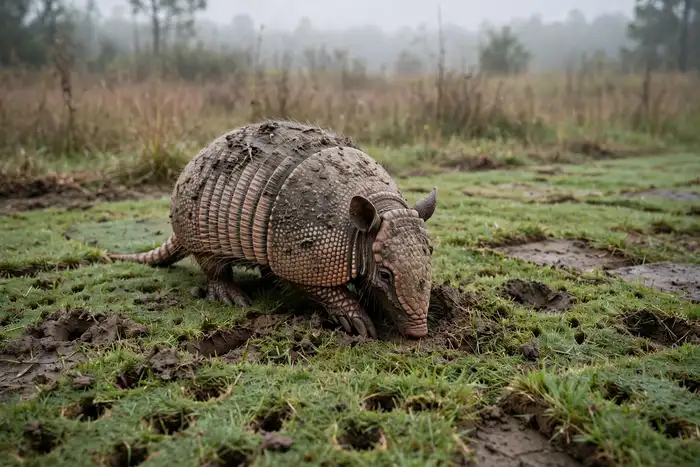
Armadillos digging up your Locust Grove yard
Armadillos are getting more common in central Georgia every year, and south Henry County is squarely in their path. In Locust Grove they spend the day in burrows in pasture, hedgerows and woods, then walk into neighboring yards at night to dig for grubs, worms and insects. A watered lawn next to a dry field is the best feeding spot around. The damage shows up overnight: cone-shaped holes across the grass, mulch flung out of beds, small plants knocked over.
Most people try home remedies first, and none of them work. Mothballs, castor-oil granules, predator urine and ultrasonic stakes don't keep armadillos away, and mothballs shouldn't be put out for any animal problem. What stops the digging is catching the armadillo that's doing it, with traps set where it already walks, and then closing off any burrow near the house.
Why yards next to open land get hit hardest
The lots that see the most digging are usually the ones that back onto land that hasn't been built on yet. The armadillo's burrow is out in the field or tree line, and your lawn is its nightly kitchen. When that neighboring tract is finally cleared for more homes, the armadillos living there don't disappear — they relocate, and some of them dig new burrows under the decks and sheds of the houses already built. So digging can actually increase while construction is going on next door.
Holes in the lawn vs. burrows under the house
The feeding holes are ugly but shallow. The bigger problem is the burrow. Armadillos like to dig under decks, sheds, porches, AC pads and slabs, and a tunnel there can wash out soil and undermine whatever is sitting on top. If you see a burrow entrance near your foundation, that's the part to deal with first.
Don't treat the lawn for grubs
It seems logical: kill the grubs and the armadillo will leave. In practice, grub treatment usually makes the damage worse. With less food in each spot, the armadillo digs more holes over a wider area looking for what's left. Pros generally advise against it. Removing the animal is what stops the digging.
How armadillos are caught
There's nothing you can bait an armadillo with. They don't respond to food in a trap the way a raccoon does. Instead, a pro finds the paths it uses — along a fence, the edge of a bed, the line from the field to the burrow — and sets box traps right on those paths, often with boards set out to guide the animal in. Placement is the whole skill. A trap a few feet off the route catches nothing.
Closing the burrow
Once the armadillo is caught, the pro checks that no young are left in the burrow and then closes it, usually by burying metal screening along the edge of the deck, shed or slab so a new armadillo can't dig back under. Leaving the burrow open just gives the next one a ready-made home.
Why one may not be the last
Mild winters and few predators mean armadillos have nothing much holding them back here, and the fields and woods around Locust Grove hold plenty of them. Catching the one digging in your yard solves today's damage, but if the next one finds the same easy lawn, it can start again. A good job watches for new activity after the first catch and makes sure burrows near the house stay closed.
Common armadillo questions in Locust Grove
Something is digging cone-shaped holes in my lawn in Locust Grove — what is it?+
Do armadillo repellents, mothballs or ultrasonic stakes work?+
There's a burrow under my deck or shed — is that an armadillo?+
How do you actually get rid of an armadillo?+
Will an armadillo damage my foundation?+
How much does armadillo removal cost in Locust Grove?+
Other Locust Grove problems that come with armadillos
Our wildlife crew handles these closely related problems — the ones that most often turn up with a armadillo issue.
Got more than armadillos in Locust Grove?
An armadillo is rarely the only animal crossing into a Locust Grove yard at night. See everything we handle locally on the Locust Grove wildlife removal hub, or jump to Georgia wildlife removal.
Want the background before you call? Read our statewide guide: Armadillos tearing up your Georgia lawn.
Serving all of Henry County
Locust Grove is one part of Henry County. See wildlife removal in Henry County, GA for the county-wide picture — the animals we get called about most, and the other towns we cover.
One call to your Locust Grove armadillo crew
An armadillo digs every night it stays, and a burrow under a deck or slab gets bigger with time. Call us and tell us about the job — we will confirm the local crew for your county before any work starts.
- Local to Henry County. Georgia DNR-compliant handling — call to ask about licensing and insurance.
- Trapping, not repellents. Box traps set on the armadillo's own paths, then the burrow closed off — sprays and granules don't work.
- Done right. Removal, exclusion and cleanup.