Bat Removal & Exclusion in Centerville, GA
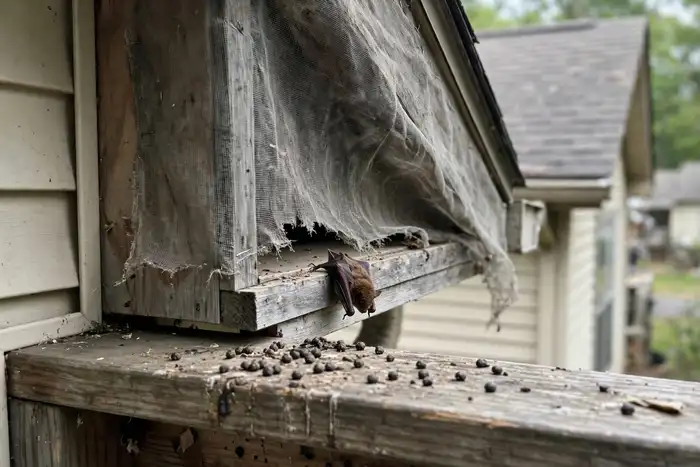
Little black pellets turning up on the porch rail or the walk below the same spot on the roof every morning? In Centerville that usually means a bat roost overhead, and the date on the calendar decides when it can come out. Call us and tell us about the job - we will confirm the local crew for your county before any work starts..
Bats in your Centerville home
Bats are the quietest animal that ends up in a Centerville house. There's no chewing and no thumping. The most common sign is the droppings: small dark pellets collecting on the porch, the deck or the ground right under a gable vent or a gap at the roof edge. Some people notice a dark stain where the bats squeeze in, or a few bats leaving at sunset. In Middle Georgia attics the usual species are big brown bats and little brown bats.
Centerville's tightly packed rooflines offer plenty of small openings. A colony needs only a gap about a finger wide, and on a street of similar houses, the same weak spot often shows up on more than one home. But bats can't be handled like a rat or squirrel. They're protected, so the job is a timed exclusion: the bats are let out and kept out, never killed. And for part of the year the colony has young that can't fly, so the calendar decides when the work can happen.
April 1 through July 31: the maternity season
From April 1 through July 31, female bats are raising pups that can't fly yet. If the openings are sealed or one-way valves go up during this time, the adults leave and the pups die inside. That's a health problem and a protected-species violation at the same time. So exclusion normally waits until early spring, before the pups are born, or until August and fall, once they can fly. If there's a real health risk and the work can't wait, Georgia DNR allows exclusion during that window when a licensed Nuisance Wildlife Control Operator does it. Inspections can happen any time.
Finding every gap
Bats don't make holes. They use the ones a house already has. On a Centerville home that's often a gable vent with loose screening, a construction gap where the roof meets a wall, a separated ridge vent, or a chimney. The pro inspects the whole roofline and may watch the bats leave at dusk to learn which gaps they actually use. Missing even one matters, because the colony will just switch to it.
Guano, lung infections and the stray bat indoors
Bat droppings (guano) can carry the fungus that causes histoplasmosis, a lung infection. When dry droppings are disturbed, the spores get into the air, so don't sweep them or vacuum them with a household vacuum. Removing guano is usually part of the job. Still, a full insulation replacement is often recommended when it isn't actually needed, so ask the pro to show you what's soiled. A single bat inside the living space is a different situation: any bat can carry rabies, so don't handle it. If it was found near someone sleeping or near a child, call public health.
How the exclusion works
A bat job usually takes two or three visits. On the first, the pro seals every gap the bats aren't using and fits a one-way bat valve over the ones they are. Bats leave at night to feed and can't get back in. After enough time has passed, the pro returns, confirms by inspection that the roost is empty, removes the valves and seals those openings for good with long-lasting materials. Small, simple jobs can sometimes be done in one day. A large colony takes longer.
Don't seal it yourself
The most common mistake is a well-meant one: you spot the gap and fill it with caulk or foam. During maternity season, or any time bats are still inside, that traps them. They die in the walls, the smell follows, and with a protected species you may also have a legal problem. Ultrasonic devices, mothballs and sprays don't move bats out either. Have it inspected, then exclude on the right dates.
Common bat questions in Centerville
I have bats in my attic in Centerville — how do I get them out?+
When can bats legally and safely be removed in Georgia?+
Are the bats dangerous — what about histoplasmosis or rabies?+
Bats are flying out of my chimney at dusk — what should I do?+
Can't I just seal the gap where the bats get in?+
How much does bat removal cost in Centerville?+
Other Centerville problems that come with bats
Our wildlife crew handles these closely related problems — the ones that most often turn up with a bat issue.
Got more than bats in Centerville?
On a street of look-alike Centerville rooflines, the opening bats found is often shared with rats or squirrels. See everything we handle locally on the Centerville wildlife removal hub, or jump to Georgia wildlife removal.
Want the background before you call? Read our statewide guide: Bats in your attic: Georgia law, maternity season and what exclusion costs.
Serving all of Houston County
Centerville is one part of Houston County. See wildlife removal in Houston County, GA for the county-wide picture — the animals we get called about most, and the other towns we cover.
One call to your Centerville bat crew
Bats don't chew, but droppings build up fast, and sealing at the wrong time traps young inside. Call us and tell us about the job - we will confirm the local crew for your county before any work starts..
- Local to Houston County. Georgia DNR-compliant handling — call to ask about licensing and insurance.
- Exclusion on the right dates. One-way bat valves outside April 1–July 31, then a permanent seal once every bat is out.
- Done right. Removal, exclusion and cleanup.