Armadillo Removal in Centerville, GA
You go to bed with a smooth lawn and wake up to a yard that looks rooted by hogs — cone-shaped holes, mulch kicked out of the beds? That's an armadillo, and it's probably hitting your neighbors' yards too. Call us and tell us about the job - we will confirm the local crew for your county before any work starts..
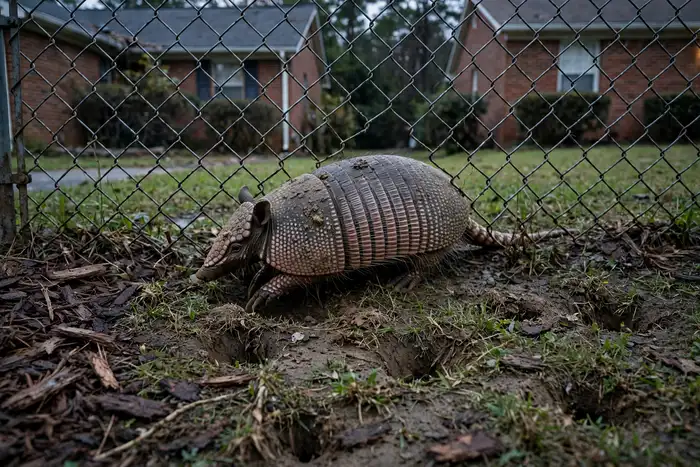
Armadillos digging up your Centerville yard
Armadillos are becoming more common across Middle Georgia every year, and Centerville's lawns are right in their path. The nine-banded armadillo eats grubs, earthworms and other insects in the soil and finds them by smell. Watered lawns and flower beds keep that food close to the surface. In a neighborhood of small, connected yards, one armadillo can slip under a fence or through a hedge and dig up several lawns in a single night. Some people say the damage looks like hogs rooted the yard: cone-shaped holes all over, mulch thrown out of the beds, plants dug up.
Most homeowners try the store shelf first, and it doesn't work. An armadillo can't be scared off by smells or sounds, and it can't be baited. What ends the digging is catching the specific animal with a trap set right on the path it already travels, then closing off the spots under decks and sheds where it likes to burrow. Here's how a Houston County pro handles it.
Holes in the lawn, burrows under the house
Armadillo damage comes in two kinds. The obvious one is the lawn: shallow, cone-shaped feeding holes and dug-up beds that reappear every morning. That's ugly but fixable. The bigger concern is burrows. Armadillos like to dig under decks, sheds, AC pads, slabs and foundations, and a burrow there can weaken the support over time. You can reseed a lawn. A tunnel under the slab is the reason not to let one settle in.
Why it's hitting your street
Centerville's small, connected lots work well for an armadillo. It can squeeze under a fence or through a hedge and move from one watered lawn to the next. Neighbors often notice the holes around the same time. After rain, when the ground is soft and worms are near the surface, the damage tends to get worse. And because our winters are mild, armadillos stay active much of the year.
What doesn't work
Mothballs, castor-oil granules, predator urine and ultrasonic stakes are all sold to keep armadillos away, and none of them reliably work. Mothballs especially shouldn't be put around a home for any animal problem. Grub treatments are generally not recommended either. With less food in the soil, the armadillo just digs harder and wider looking for it, and the damage gets worse. Every week spent trying these is another week of fresh holes.
What works: traps in the right place
Since there's nothing that reliably baits an armadillo, the skill is in where the trap goes. Pros usually use wooden box traps. They study the yard to find the burrow entrances and the paths the armadillo uses, often along a fence, a foundation or a garden border, then set the traps right on that path with wings or boards guiding it in. Placed correctly, the trap catches the animal causing the damage. Georgia has no legal restrictions on trapping armadillos.
Closing the burrow
Catching the armadillo is half the job. The other half is making sure the next one can't move into its burrow. After confirming the burrow is empty, including checking for young, the pro fills it and installs buried barrier screening around decks, sheds and slabs so a new armadillo can't dig back in. In a neighborhood where another one may be a few yards away, that barrier is what keeps the problem from returning.
When more than one shows up
Armadillos have few natural predators here and no cold winter to slow them down, so once one finds a good lawn, others may follow the same fence lines in. Catching one animal doesn't always end it. A thorough job keeps an eye out for new activity and secures any burrow that gets reopened.
Common armadillo questions in Centerville
Something is digging cone-shaped holes in my lawn in Centerville — what is it?+
Do armadillo repellents, mothballs or ultrasonic stakes work?+
There's a burrow under my deck or shed — is that an armadillo?+
How do you actually get rid of an armadillo?+
Will an armadillo damage my foundation?+
How much does armadillo removal cost in Centerville?+
Other Centerville problems that come with armadillos
Our wildlife crew handles these closely related problems — the ones that most often turn up with a armadillo issue.
Got more than armadillos in Centerville?
Armadillos aren't the only animals crossing Centerville yards after dark. See everything we handle locally on the Centerville wildlife removal hub, or jump to Georgia wildlife removal.
Want the background before you call? Read our statewide guide: Armadillos tearing up your Georgia lawn.
Serving all of Houston County
Centerville is one part of Houston County. See wildlife removal in Houston County, GA for the county-wide picture — the animals we get called about most, and the other towns we cover.
One call to your Centerville armadillo crew
An armadillo digs every night, and a burrow under a slab or deck gets bigger over time. Call us and tell us about the job - we will confirm the local crew for your county before any work starts..
- Local to Houston County. Georgia DNR-compliant handling — call to ask about licensing and insurance.
- Trapping, not repellents. Box traps placed on the armadillo's own path — store-bought sprays, granules and mothballs don't work.
- Done right. Removal, exclusion and cleanup.